








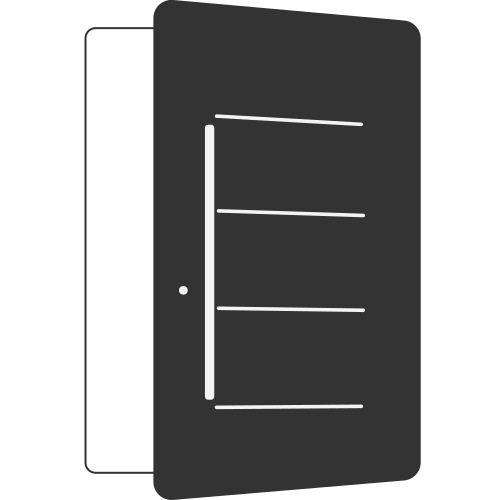

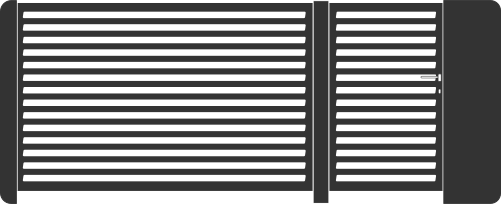
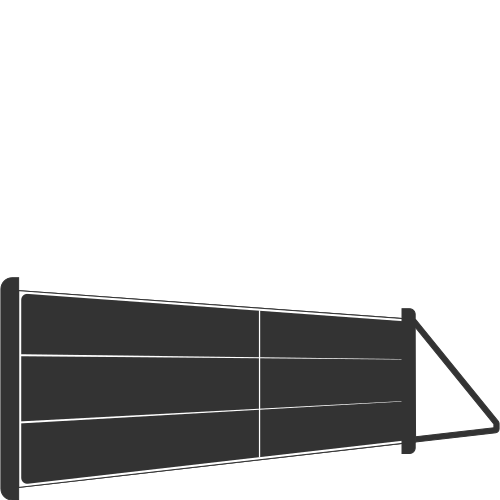





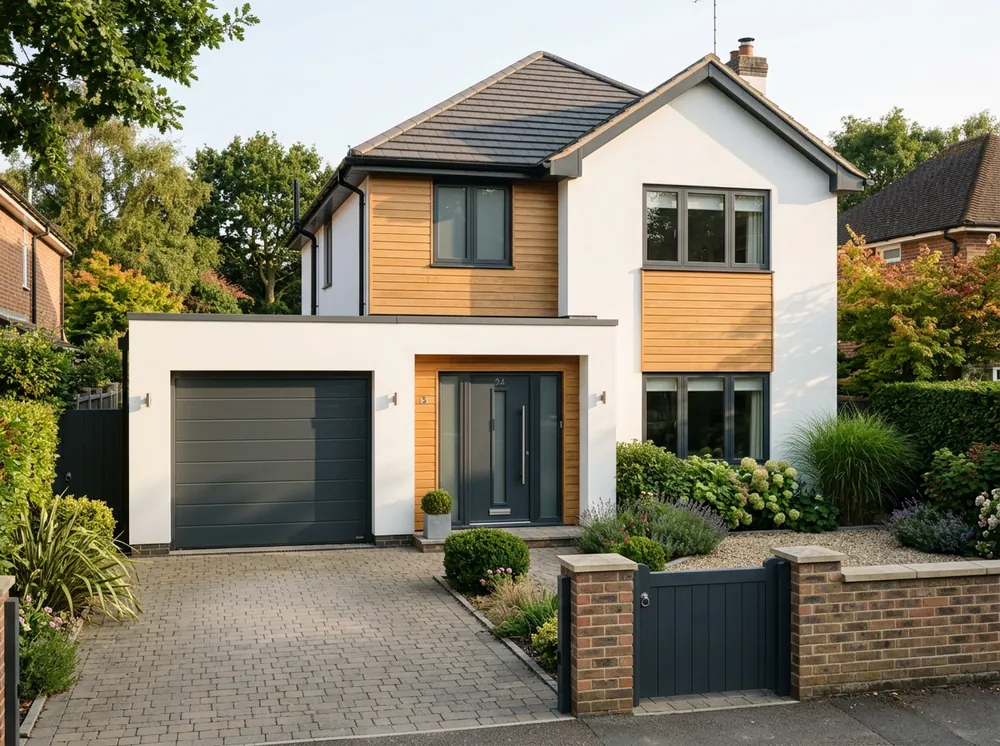
A boundary is the first thing a visitor reads about a home1. Choosing one comes down to four questions: what it is for, how high it may be, how much you want to see through it, and how you will get in.
What is the fence for?
Privacy, security, a frame for the garden, a line for children and dogs, or simply a finished front to the house. The answer sets the height and how open the design can be.
Our fence system brings posts, segments, wickets, gates and a post that takes parcels into one visual language and one specification1, so the purpose can change along the boundary without the look changing.
Height
Check the planning rules before you settle on a height. In England, a fence, wall or gate next to a road used by vehicles, or its footpath, can usually be up to 1 metre high without planning permission; elsewhere the limit is 2 metres2, 3. Listed buildings, planning conditions and Article 4 directions change this2, so read our planning guide or ask your council.
Our system gates run from 0.6 to 2.4 m high, and INFINITY segments reach 2 m1.
How much do you want to see?
Designs fall into three kinds: open, semi-open and solid1. For real privacy, HOME INCLUSIVE is designed for it, with 500 mm panels, louvres or a solid sheet1. In MODERN, the solid and perforated sheet designs do the same job with a lighter look1. For a frontage you want to show, STYLE uses slender 12 × 12 mm rods and stays transparent1.
Six collections
Six collections share the same posts, gates, wickets and MultiBox post, so the choice is about character, not compatibility1.
| Collection | Character | Designs | Material | Best for |
|---|---|---|---|---|
| MODERN | Horizontal slats, perforated and solid sheets | 22 | Aluminium, steel | Contemporary houses, paved frontages |
| HOME INCLUSIVE | Louvres, deep panels and solid sheets | 9 | Aluminium, steel | Privacy, street-facing plots |
| INFINITY | A palisade with no vertical posts, up to 2 m | 4 | Aluminium, steel | Long boundaries, uninterrupted lines |
| CLASSIC | Closed box sections with caps | 16 | Aluminium, steel | Period and modern homes, railings on walls |
| STYLE | 12 × 12 mm rods with shaped tops | 13 | Steel | Open frontages, sloping plots |
| LUX | 14 × 14 mm rods and simple ornaments | 18 | Steel | Large plots, formal gardens |
The collections and counts are those of our Fences page1.
Steel or aluminium
Steel gives the widest choice and the toughest structure, protected layer by layer: iron phosphating, hot-dip galvanising inside and out, chrome-free passivation and a powder coating1. Zinc plus coating is the DUPLEX system1, and our fence product pages state that the galvanising follows EN ISO 14614, 5.
Aluminium is light to install, has no visible welds, never needs repainting and is fully recyclable. There are 12 aluminium designs across four collections1.
The way in
Gates, wickets, segments and posts are one system, so designs and colours carry across1. There are three ways in for a car:
- Sliding. Glides along the fence line and needs a run-back of about the opening width to one side. The cantilever design leaves no track across the drive, so leaves and snow do not stop it1.
- Double-leaf. Needs swing depth on the property side but no side run-back: the choice for plots too narrow for a sliding gate1.
- Folding. Half the swing of a double-leaf gate and up to twice as fast, in widths from 3 to 6 metres1.
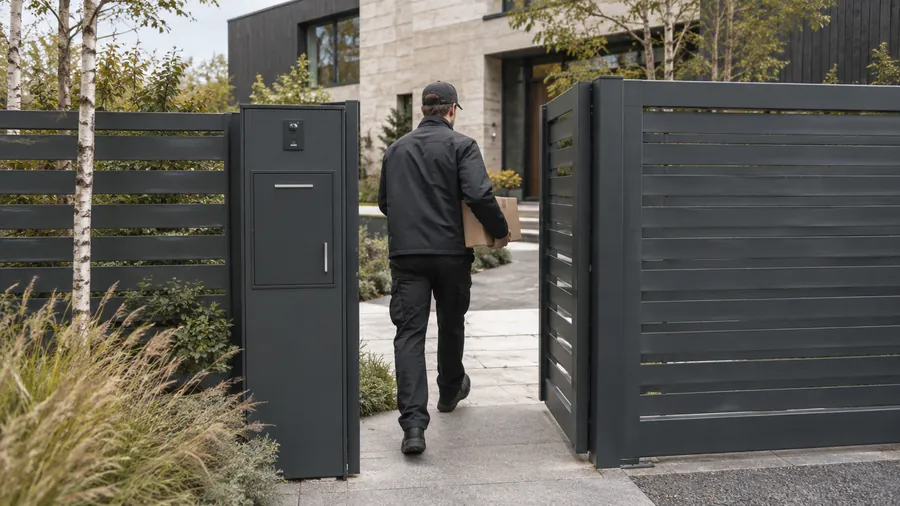
Safety edges, photocells and the drive housed in the post belong to the automatic versions1. For people, a wicket keeps the path apart from the drive, and a MultiBox post adds a letter slot, with a parcel slot and video door phone as options1.
Colour
There are seven standard RAL colours, four special colours, two textured coatings, six Home Inclusive 2.0 shades and eleven wood- and stone-look DECOR finishes1. Screen colours are approximations, so we bring samples to the survey1.
Before you order
- Measure the frontage and any sides you want to enclose.
- For each gate, note the opening width, the space beside it along the fence and the depth inside it: the three numbers that decide which gate fits1.
- Check the boundary line, and the planning rules for your height.
- Decide where you need power for an automatic gate or a MultiBox post.
Foundations, posts and automation are confirmed at survey, and every quotation comes with a written specification1.
From the catalogue
Products in this guide
 FenceMODERN fence collectionView product
 FenceCLASSIC fence collectionView product
 FenceSTYLE fence collectionView product
 FenceLUX fence collectionView product
 FenceHOME INCLUSIVE fence collectionView product
 GateSliding gatesView product
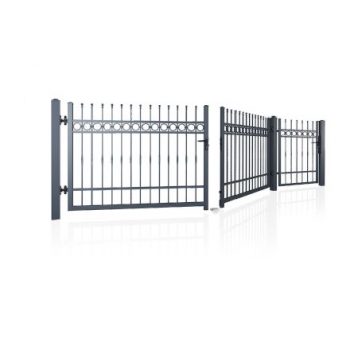 GateSwing gates and wicketsView product
Sizes, finishes and prices are on each product page. Made-to-measure products are confirmed at survey and in your written quotation.
Sources
- Fences: Draw the line (Watford Construction)
- Fences, gates and garden walls: planning permission (Planning Portal)planningportal.co.uk
- The Town and Country Planning (General Permitted Development) (England) Order 2015, Schedule 2, Part 2, Class A (legislation.gov.uk)legislation.gov.uk
- Fence collections, gates and wickets: product pages, Watford Construction shop
- BS EN ISO 1461:2009 Hot dip galvanized coatings on fabricated iron and steel articles (BSI)knowledge.bsigroup.com
Product figures are the manufacturer’s published values as held in our catalogue; every specification is confirmed for your order in writing.
Keep reading

Talk it through with us.
Bring your measurements, photos and questions. We will help you find what fits, and confirm every detail before anything is made.
Customer Care +44 (0) 330 818 0713 · Monday to Saturday 8 am to 8 pm, Sunday 10 am to 5 pm (UK time)
General guidance, written in October 2026. Specifications, sizes and finishes are confirmed at survey and in your written quotation; the terms that apply to an order are in your order confirmation and our Terms and Conditions. Images are concept visualisations unless they show a product from our catalogue.
